What should a music agent do without asking?
A music agent can be very free with what you hear and very careful with what you spend. Both at once.
Picture an agent that looks after your music. It builds your playlists, keeps an eye on the artists you love, tells you when they're touring and books the tickets.
How much of that should it do without asking you first?
In Earned autonomy I set out the model. An agent climbs a ladder of trust with each person, from suggesting things up to acting and only checking in when something is unusual. Each kind of action gets its own ladder, and how easy a mistake is to undo decides how high that ladder goes, how much evidence it takes to climb and how far one mistake drops it. Jeff Bezos called the two kinds one-way and two-way doors in his 2015 letter to shareholders.
This piece works that through for one product, an agent that looks after your music.
The rules, briefly
Two-way doors climb after a few yeses, can reach the top rung and drop one rung after a mistake. Actions that are costly to undo climb more slowly and stop a rung or two short. One-way doors need lots of evidence, mostly stop at "prepare", and go back to the start after a mistake.
Anything involving money also gets split by amount. "Buy tickets under £50" and "buy tickets over £200" are separate ladders.
And the agent never moves itself up quietly. It offers the next rung out loud. "You've said yes to the last eight presale reminders. Want me to just set them?"
What that means for a music agent
| Action | Door | Where it can get to |
|---|---|---|
| Queue songs, skip, build a private playlist | Two-way | The top, almost straight away |
| Save a track, follow an artist | Two-way | The top |
| Presale reminders, add a gig to your calendar | Two-way | The top |
| Pencil in the date and say how long until it sells out | Two-way | The top |
| Change a playlist other people follow | Costly to undo | Act and tell |
| Buy a ticket you can return | Costly to undo | Act and tell, under your usual price |
| Buy a ticket you can't refund | One-way | Prepare, or act and tell for nights you always go to |
| Buy on resale above face value | One-way | Always ask |
| Buy tickets for friends | One-way, other people's money | Prepare |
| Share a track or post as you | One-way, your reputation | Suggest |
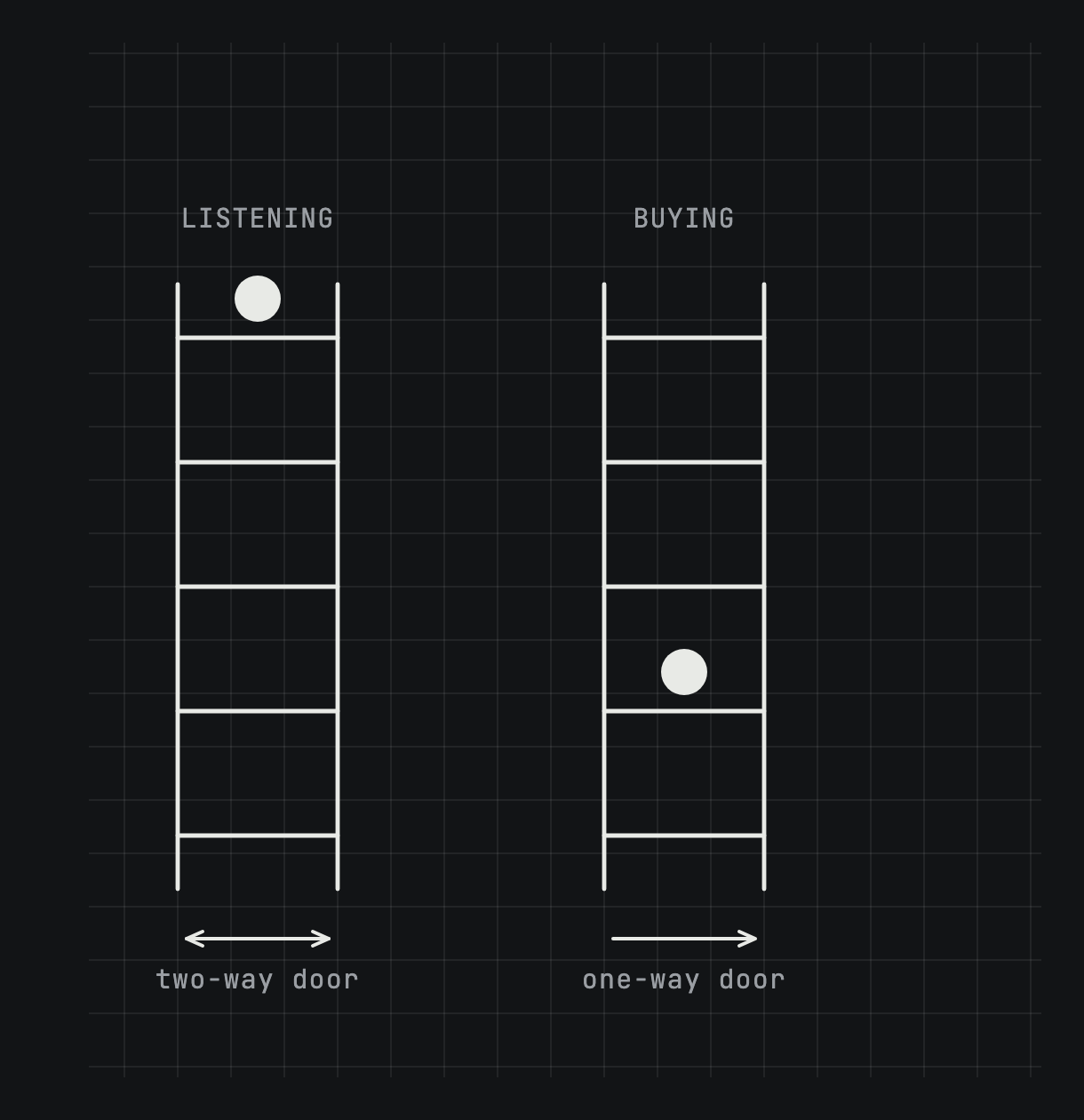
Listening is two-way, buying is one-way
The table splits cleanly. Almost everything about what you hear is a two-way door. A bad song costs you a skip. A bad playlist costs you a minute.
Almost everything about what you spend is a one-way door, or close to one.
So a good music agent can be very autonomous about listening and careful about buying, at the same time, for the same person. Nobody has to pick one autonomy setting for the whole product.
Listening also climbs fast because the evidence is constant. Every song you don't skip is a small yes. Every save is a bigger one. An agent can learn more about your taste in a week of listening than it will learn about your ticket buying in a year.
The platform can change the door
Whether buying a ticket is a one-way door isn't fixed. It depends on how the ticketing works.
Dice has let fans return tickets for a full refund since 2017, with the ticket going to the next person on the waiting list (Music Week). It depends on the event and on someone wanting the ticket, but where it works, buying a ticket stops being a one-way door.
That means an agent on a platform like that can safely do more on its own than an agent on a site with no returns. The ticketing rules become part of the agent's design. For a ticketing company building agents, a good returns policy is the thing that lets the agent be useful.
The same move works anywhere. Pencil in the date and warn you before it sells out, instead of buying. Wait a minute before posting, with a cancel button. Pick the refundable option when it costs a little more. Every one-way door you turn into a two-way one is a place the agent can do more.
What looks unusual to a music agent
The top rung only works if the agent can tell when something is different from normal. For music that has a very specific shape.
- A price well above what you usually pay, or a resale price above face value.
- An artist a long way outside your taste.
- A venue far from where you usually go.
- A date that clashes with something in your calendar.
- More tickets than you normally buy.
Any one of those should drop the action down a rung for that one decision. "I'd normally just buy these, but they're £340 each on a resale site. Can you check?"
Other people make it one-way
The actions that should stay lowest on the ladder are the ones that involve someone else. Buying tickets for your friends spends their money and makes plans for them. Sharing a track or posting about a gig speaks for you in public.
Those stay low however good the agent's track record is with you, because the person who'd pay for a mistake never said yes to the agent.
Try it
Gig Agent is a working prototype of this. There are four listeners with very different histories: one brand new, one who has booked 38 nights, one who books for his mates and one the agent let down in July. Reply in your own words and an earned autonomy agent reads each reply and moves the ladders.
FAQ
What should a music AI agent do without asking? Things that are easy to undo, like queueing songs, building private playlists, following artists and setting presale reminders. Buying tickets, spending other people's money and posting as you should need your confirmation until the agent has a long track record, and some should always ask.
What are one-way and two-way doors? A way of sorting decisions from Jeff Bezos's 2015 letter to Amazon shareholders. A two-way door is a decision you can easily reverse. A one-way door is one you can't. For agents, two-way doors can be handed over quickly and one-way doors need much more trust.
Can an AI agent buy concert tickets for you? It can, but it should earn the right to, one step at a time. Start with reminders and pencilling in dates with a warning before they sell out, then buying with your one-tap approval, and only buy on its own for gigs that match what you always do, at prices you normally pay, ideally where tickets can be returned.