Is Apple an augmented reality company?
The 2018 case that Apple was quietly becoming an AR company: ARKit, the iPhone X, wearables and the headset to come.
First published on Medium in April 2018. The original text is kept as written, with spelling fixed. Images credited to other sites are linked rather than copied.
2026What happened next
Apple answered the question in 2024 with Vision Pro, a headset it calls a spatial computer rather than an AR device. The groundwork described here (ARKit, depth sensing, chips and wearables built to work together) is what made it possible. Whether AR glasses become the everyday product this post imagined is still open.
The original post · April 2018
I believe a large part of Apple’s forward-looking strategy is becoming the world's leading Augmented Reality company. I would even go as far as saying betting on Apple over the next 10 years is a bet on the widespread adoption of AR as it is anything else. In this article I want to outline the support for this theory and why I think it is an amazing strategy.
Apple’s Device Focus
For the last 10 years Apple has been a mobile device company. By owning the device (iPhone, iPad and to some degree the MacBook) it can control the platform and take pretty large and healthy commissions from the digital content (Apps, IAPs and Music) it delivers to all its users.
76% of Apple’s revenue comes from mobile device sales alone (69.7% of that is from iPhone sales). That’s $67M of Apple’s $88M dollars in quarterly revenue as reported in its 2018 Q1 summary. It also recently reported 1.3 Billion device installs. That’s roughly 20% of the global population.
Recent drops in Apple’s shares prices shows how sensitive the market is to news about its iPhone sales. Further support that Apple is a device first company.
Platform Revenue Streams
Approximately 9.5% of Apple's revenue comes from digital content sales. Leaving only 14% to new product lines and its other hardware sales like the MacBook.
This 9.5% comes mostly from the content it hasn’t funded (like Netflix Originals for example) it makes money from content sales by just owning the platform. By owning the platform apple takes 30% revenue share of all digital content sales. So 30% of all money Pokemon Go, Candy Crush and Clash of Clans makes goes directly to Apple as it owns the platform and devices people use daily.
Therefore 86% of all revenue comes from either the direct sales of its mobile devices or revenue from the platform the device sales creates.
Apple's Reluctance To Run Ads
Apple has recently made it clear (through a heated exchange of words back and forth between Tim Cook and Mark Zuckerberg) it doesn’t want to monetize people's data (via Advertising like Google and Facebook).
We could make a ton of money if we monetized our customers. If our customers were our product. We’ve elected not to do that. …We’re not going to traffic in your personal life. Privacy to us is a human right, a civil liberty.
Tim Cook — MSNBC March 28th 2018
If that’s not its long-term focus then Apple has to double down on what it knows best, selling amazing devices and making money from high-quality content via its associated platform (the AppStore and iTunes).
Forward-Looking Device Strategy
So how do you build the device and platform people use daily?
- Make devices people love and aspire to own. Apple's dedicated focus on design, the camera and making a consumer product people aspire to own (e.g. the iPhone X strategy) is fantastic at covering this area.
- Help developers make new and novel content users love. If the content is only available on iOS then users will come.
Let’s call this the “device first virtuous cycle”.
Cool camera features, AR features, rich vibrant retina screens, advanced image and face processing and high-value iPhones are all part of this device first strategy.
So what is the future of Apple devices? I think Apple’s device strategy is an AR centric strategy. Here is why….
Apple devices are becoming more pervasive
Apple’s devices are becoming more pervasive. The AirPods, HomePod and AppleWatch are great examples of devices that fit naturally into your daily lives. Apple has mastered how to build small luxury consumer products that people love to wear and use daily. The advancement in voice recognition, small long-life batteries and Bluetooth connectivity have enabled the Apple Watch and AirPods to work seamlessly with the iPhone.
If augmented reality experiences are to land well and get widespread adoption the hardware and software will have to co-exist and the devices will have to fit into our daily lives. Apple certainly has this skill mastered.
Apple is filing AR patents.
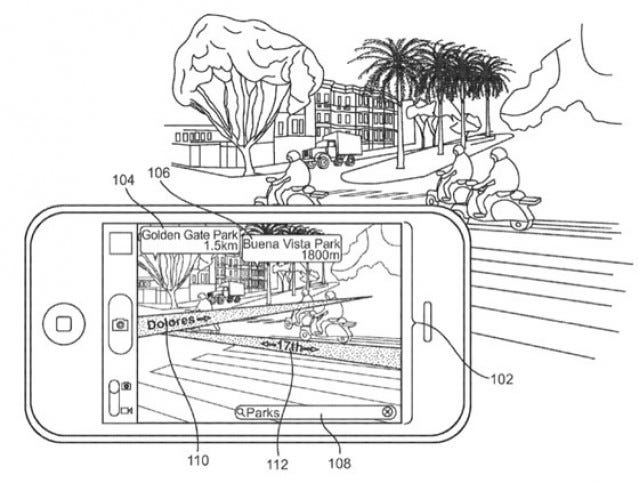
Below are two examples of the many patents Apple is filing related to AR. The first shows a user holding up an iPhone and searching for “Parks” and then getting directions, labels and annotations showing the parks in the area.
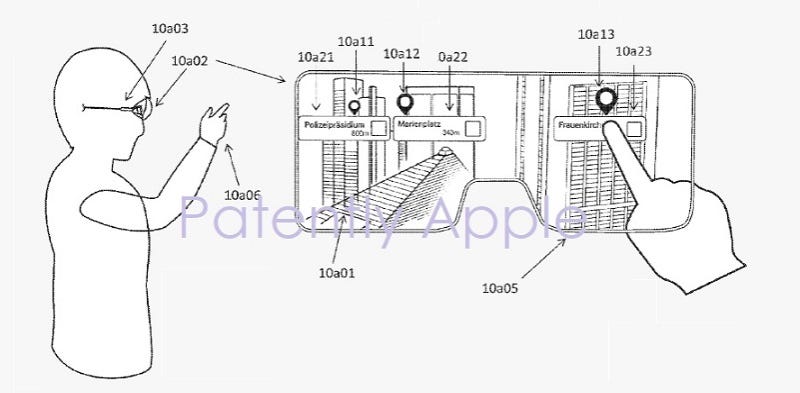
The second shows a user wearing AR glasses, the world around them is augmented with notes, markers and labs. The user can also interact with them in the virtual space using their finger as shown.
Apple is acquiring AR companies
Since the start of 2015 Apple has acquired 29 companies. 13 have been AR related. Some notable companies include:
- Metaio a German company acquired in 2015. They won awards for the best AR developer SDK and I’m sure their talent and code went into Apple's new ARKit.
- The technology and talent from Perceptio, Faceshift and Emotient combined to create the Face ID system and Apple's expressive Animoji.
- Machine Learning companies Turi (Acquired for $200M) from the US and Tuplejump from India helped build out the CoreML offering. This is fundamental to building AR experiences and finding features such as surfaces, walls, faces and common objects.
- SensoMotoric Instruments added eye tracking hardware and software to ARKit.
- Vrvana (Acquired for $300M) have been working on an AR headset. Maybe this technology will feed Apple's new devices or even help them develop their own XR (VR and AR) headset.
- Shazam (Acquired for $400M) although best known for its Music recognition software and a large database of music interests it is also a massive player in AR marketing for big brands. Its image processing technology and Shazam codes have helped it collaborate with massive brands such as Coca-Cola, Disney and BMW on building AR marketing experiences for anyone with a smartphone.
Vrvana
Vrvana was acquired by Apple for 300M in September 2017. They have built a mixed reality (VR and AR) headset called Totem. Updates to their blog and website have been paused since being acquired but I was able to find some information on their headset.
Totem uses hand tracking and inside-out positional tracking to manipulate virtual objects with their hands wherever they please. Totem’s ability to seamlessly blend the real world with the virtual enables the creation of unique mixed reality experiences.
The headset has a wide field of view at a high resolution, faster than the human eyes can perceive. This allows your people to build experiences that enable users to be completely immersed. One of the major highlights is the headset reportedly uses an “accelerated chroma keying” which eliminates the need for external tracking or projection equipment, simplifying setup and giving users freedom to move and accomplish more.

Shazam
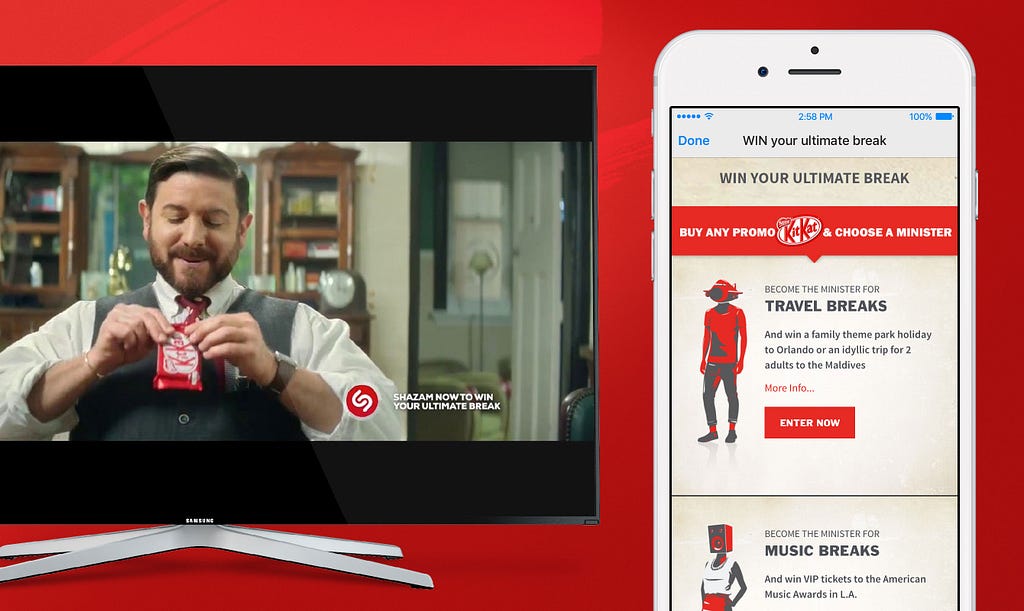
The recent Shazam acquisition is as much as music as it as an AR acquisition. Using the camera in the Shazam app users can Shazam QR like codes. Big brands including Disney, Coke, Nestle, Pepsi, McDonalds and BMW have partnered with the company. Mixing traditional media outlets like posters, TV and video spots with the Shazam app to generate fun AR experiences.
This has been very popular with marketing groups in the UK, Australia and New Zealand. It is also starting to win big customers in the US and Shazam code was recently embedded in the SXSW ticket.
In May 2016, confectionery giant Nestle Shazam-enabled 4.7 million Kit Kat bars across Australia and New Zealand.
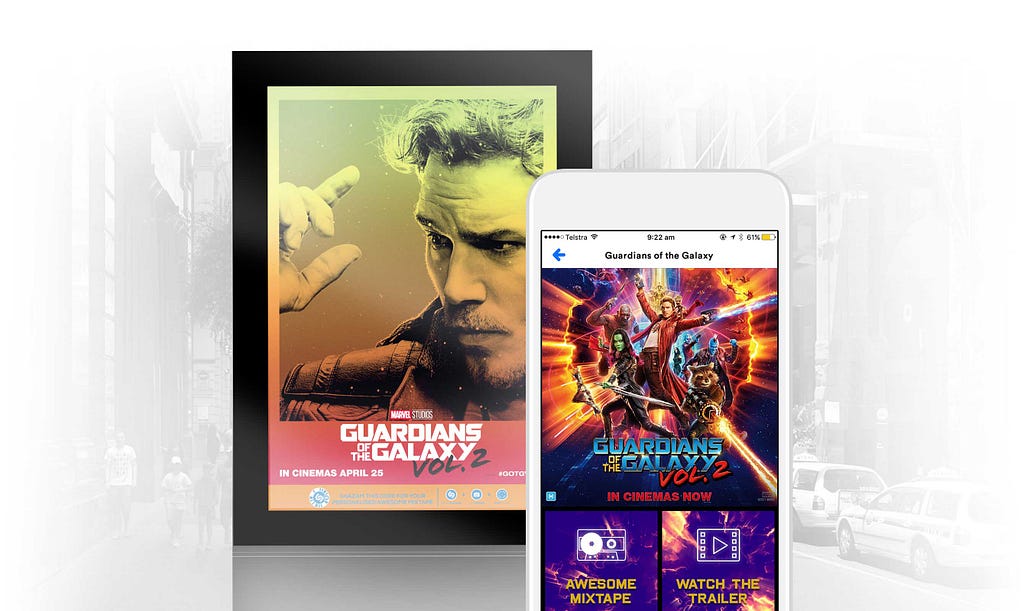
In April 2017, Disney partnered with Shazam to promote the blockbuster Marvel Comics superhero film “Guardians of the Galaxy 2” in Australia.
Disney utilized Shazam’s visual-recognition technology across multiple channels to deliver fans a personalized “Awesome Mixtape” in the form of a Spotify playlist. The adventures continued in a custom Shazam result that included a shareable Galactic Selfie, trailer and the opportunity to purchase tickets, all amplified via in-app media at scale.
Bombay Sapphire leveraged Shazam’s augmented reality solution in airports in the US and Singapore, bringing its iconic bottle to life through the use of a Shazam code printed on a sleeve.
Upon “shazaming” the code, the ten botanicals from the Bombay Sapphire logo appear to grow out from the bottle. The augmented reality experience continues by allowing users to watch ‘how to make’ videos for drink recipes.
Promoting AR Development
At Apple's worldwide developers conference (WWDC) in 2017 Apple released ARKit.
Apple has been hard at work on making the developer kit easy to use and well documented. They have online tutorials, example projects, and loads of helper guides and design advice available here. It’s clear that Apple has learned if you give developers the tools, guidance, documentation and nudge they need amazing experiences are built.
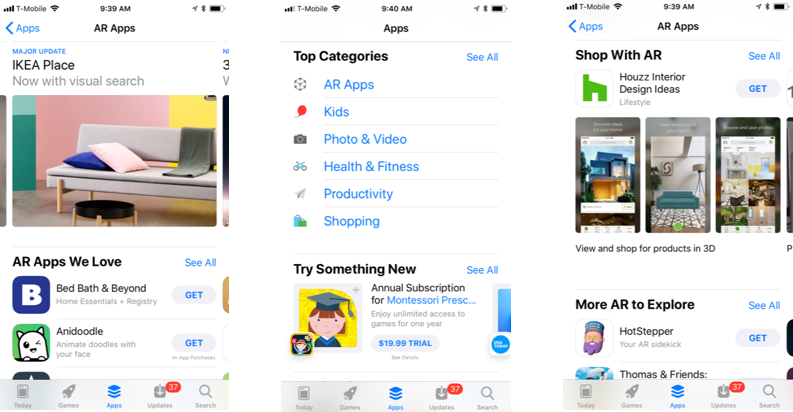
As well as fostering a popular developer ecosystem Apple is heavily promoting AR apps on their app store. App discoverability is critical to the success of an app especially as the App population explodes and the number of high-quality content markers matures. It’s clear that Apple wants to help and promote AR development by giving AR apps an advanced in being discovered on the App Store.
The CEO Believes
Tim Cook believes in AR and how AR features can both drive device sales and create amazing applications. Cook said there are “fantastic” people at Apple who are working on incredible things, and that Apple is in a “unique position” to lead when it comes to augmented reality.
“I view AR as profound. Not today, not the app you’ll see on the App Store today, but what it will be, what it can be, I think it’s profound, and I think Apple is in a really unique position to lead in this area.”
He sees how AR can create apps that help humanity.
“Augmented reality amplifies human performance instead of isolating humans…… It’s a help for humanity, not an isolation kind of thing for humanity.”
He also explained the growth in developers making apps using the new ARKit in iOS 11+
” There are more than 1,000 ARKit apps in the App Store now, across a wide range of categories like shopping, gaming, entertainment, and business.
Quotes above are from Tim Cook as he received several questions about AR during 2017 Q4 earnings call. He was, of course, questioned about augmented reality hardware, a question he dodged by explaining that Apple’s all about the experience. This is where Apple’s current focus is publicly but with the acquisition of Vrvana for $300M and the AR patents seen above I’m sure there is a talented design team working on some fantastic AR centric hardware.
Conclusion
I believe Apple’s long-term strategy is to own the device and platform we use daily. It's been the cornerstone of their strategy over the last 10 years and it continues to be its focus and mission. Mixing hardware and software to generate products people love is something Steve Jobs always preached and Tim Cook, Johnny Ive and the Apple leadership still continue on that path.
In order to advance and create fantastic devices and content customers love I believe Augmented Reality is a big part of Apple's “device first strategy”. I’m excited to see what Apple releases next but I’m sure AR will feature heavily in the next 5 years as Apple continues to lead the charge in device and experience innovation.