Intent testing: a guide to measuring demand before you build
What intent testing is, how to run one with a landing page and ads, and how to read the results before committing to build.
First published on Medium in March 2020. The original text is kept as written, with spelling fixed. Images credited to other sites are linked rather than copied. Faraday was a concept-testing platform I founded; it went on to become Tapkit, which was acquired by noissue in 2022. The Intent Test tool no longer exists, but the method still holds.
2026What still holds
Faraday became Tapkit, which was acquired by noissue in 2022, and the Intent Test tool didn't make the journey, so you can't use the tool this guide walks through. The method still works, and I'd still run it before building anything: put a real proposition in front of a real audience through an ad, send the people who click to a simple landing page or sign-up form, and measure how many take the next step. The ad platforms and no-code page builders now do what Faraday bundled together.
What has changed is the rulebook. Testing demand for a product that doesn't exist yet, collecting sign-ups and tracking ad clicks all come with more obligations in 2026 than they did in 2020, from consent for tracking to being honest that a product isn't available yet.
The original post · March 2020

Intent testing is a concept testing method that helps you get an early indication of how your business idea performs with your target audience. In this article, you’ll learn how to easily perform intent testing using Faraday’s own intent test tool. We’ll also show you how to analyze the results and take further action.
We promise you won’t need any technical know-how or any marketing prowess. 😃
What is intent testing?
Before we speed off into the nitty-gritty, let’s define intent testing first. Here’s a good definition of an “intent test” from the Faraday website.
“Put your ideas, creatives or propositions in front of thousands of real customers and quickly see what peeks interest.”
Intent testing is a concept testing method where you put your business ideas, creatives, or propositions in front of real “prospects” and see if there’s any interest. It’s an effective way to validate any business idea you may have, especially at an early embryonic stage. Too often, too much time, money and resources are spent developing ideas before they’ve even been tested. Faraday allows you to quickly test out whether there is real intent for your idea by using real-world ad audiences.
It’s a good idea to intent test your business ideas (pun intended 😉) to avoid investing in ideas and propositions that won’t be successful, before spending too much time and money — as well as give you information about your potential customers.
What is Faraday’s Intent Test tool?
Faraday’s goal is to help business owners and enthusiasts like you minimise the potential risk on your ventures by validating ideas first and gathering customer feedback and information.
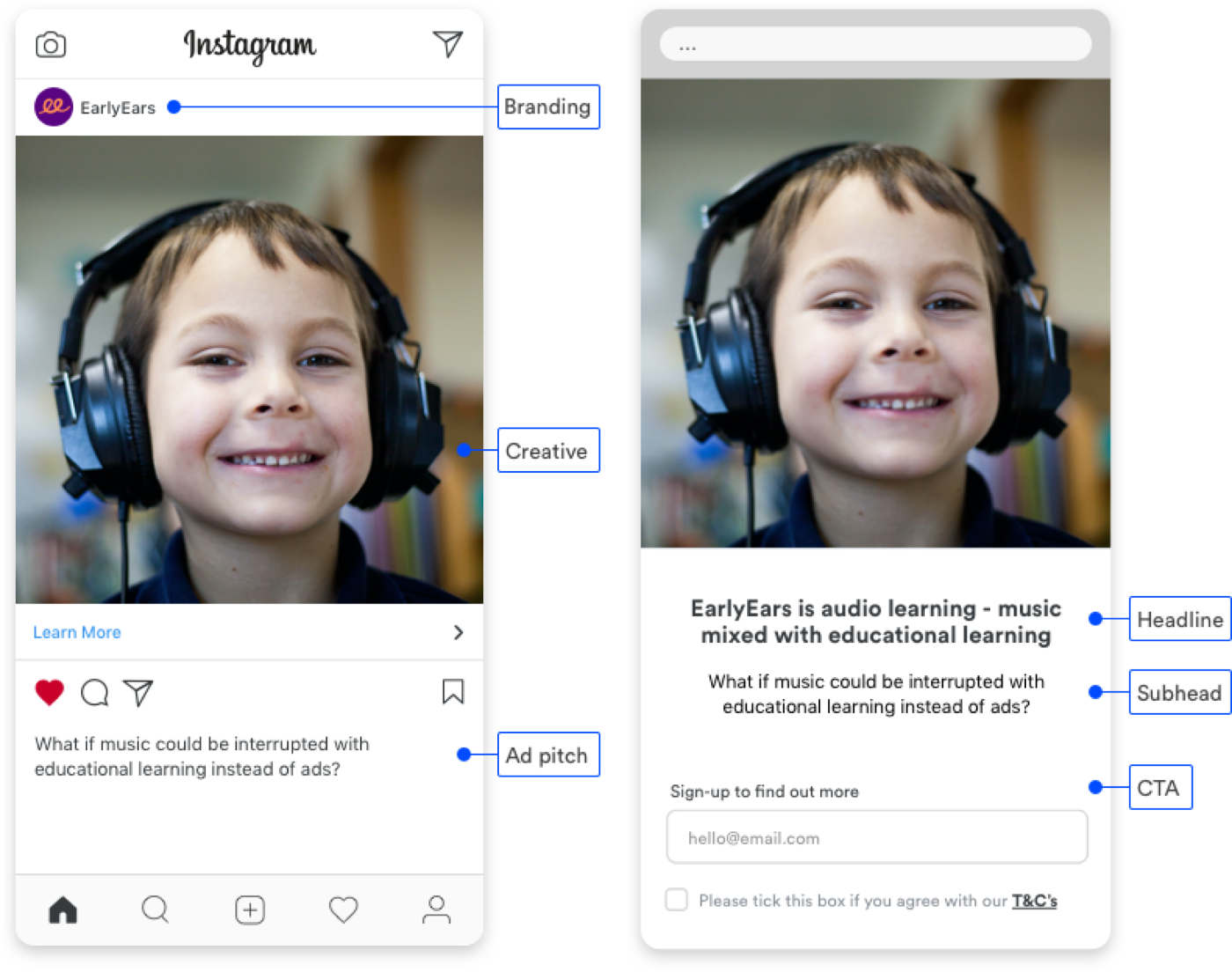
Faraday’s Intent Test was made up of three screens or windows:
- Instagram ad (to reach and target your audience like you would if your business was up and running)
- Lead form (to capture sign-ups — a strong signal of intent)
- Success screen (A completion window for users who make it through the complete funnel)
Think of it as an easy-to-use intent testing machine that uses Instagram as a springboard. Under the hood, you would be able to customize the test completely including the following:
- Name and brand
- Copy (including headline and subhead)
- Creative
- Audience
- Budget
And the cherry 🍒 on top? The reports are super detailed — complete with the overall stats, page views, cost per sign-up score, summary, and the leads you gained.
So how do you start building your own intent test? Let’s dive right in!
Designing your intent test
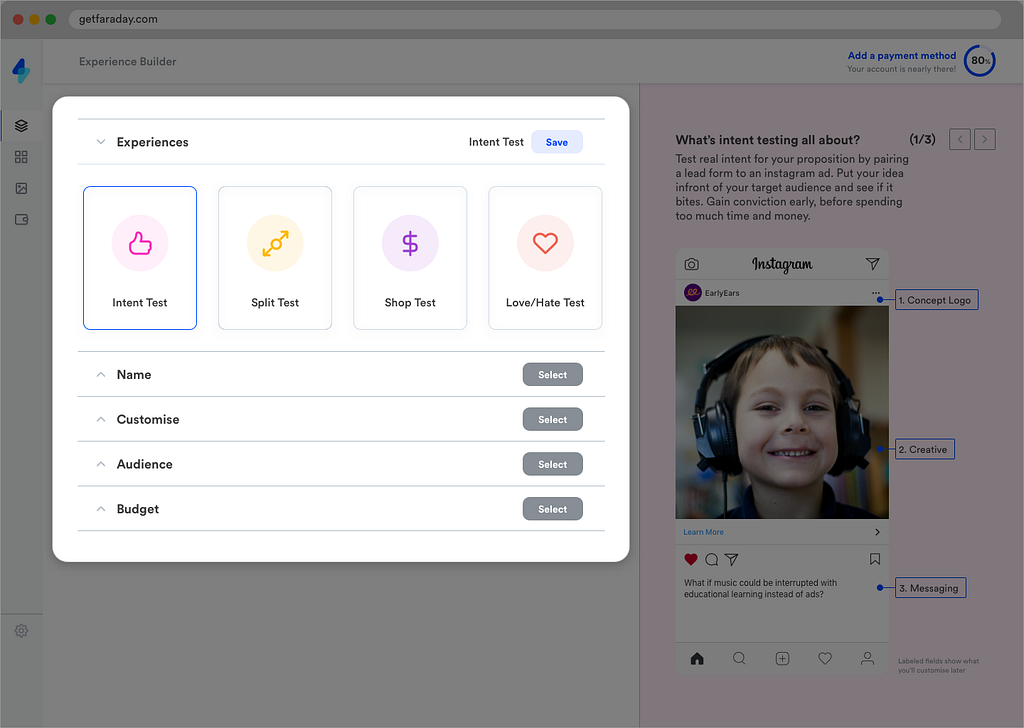
Designing an intent test on Faraday is easy. Once you’ve selected your type of research experience, in this case an ‘Intent Test’, all you need to do is follow the step-by-step builder (If you missed it scroll up to the video that walks you through this process) Those 5 dropdown steps are: Experience, Name, Customise, Audience and Budget.
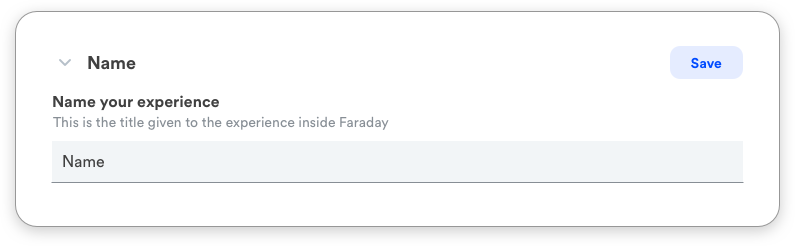
Name
To start, you should give your test a name. This would represent the title of your test or experience inside Faraday
Customize
Next you’ll customize the different parts of your ad and lead form. You’ll be able to edit:
- Brand logo
- Creative image
- Advert copy
- Headline
- Subhead
- Call to action (CTA)
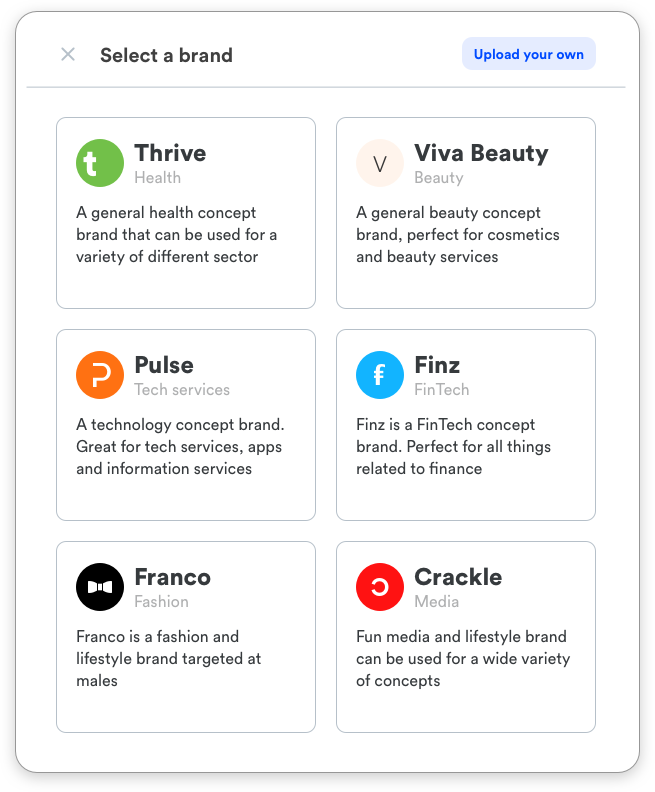
When adding a brand logo, you can upload your own or use one of Faraday’s pre-made stealth brands. These cover a span of industries and are perfect if you want to save on design costs or are lacking in the creative skills department! If you don’t want to expose your own brand quite yet, use a stealth brand.
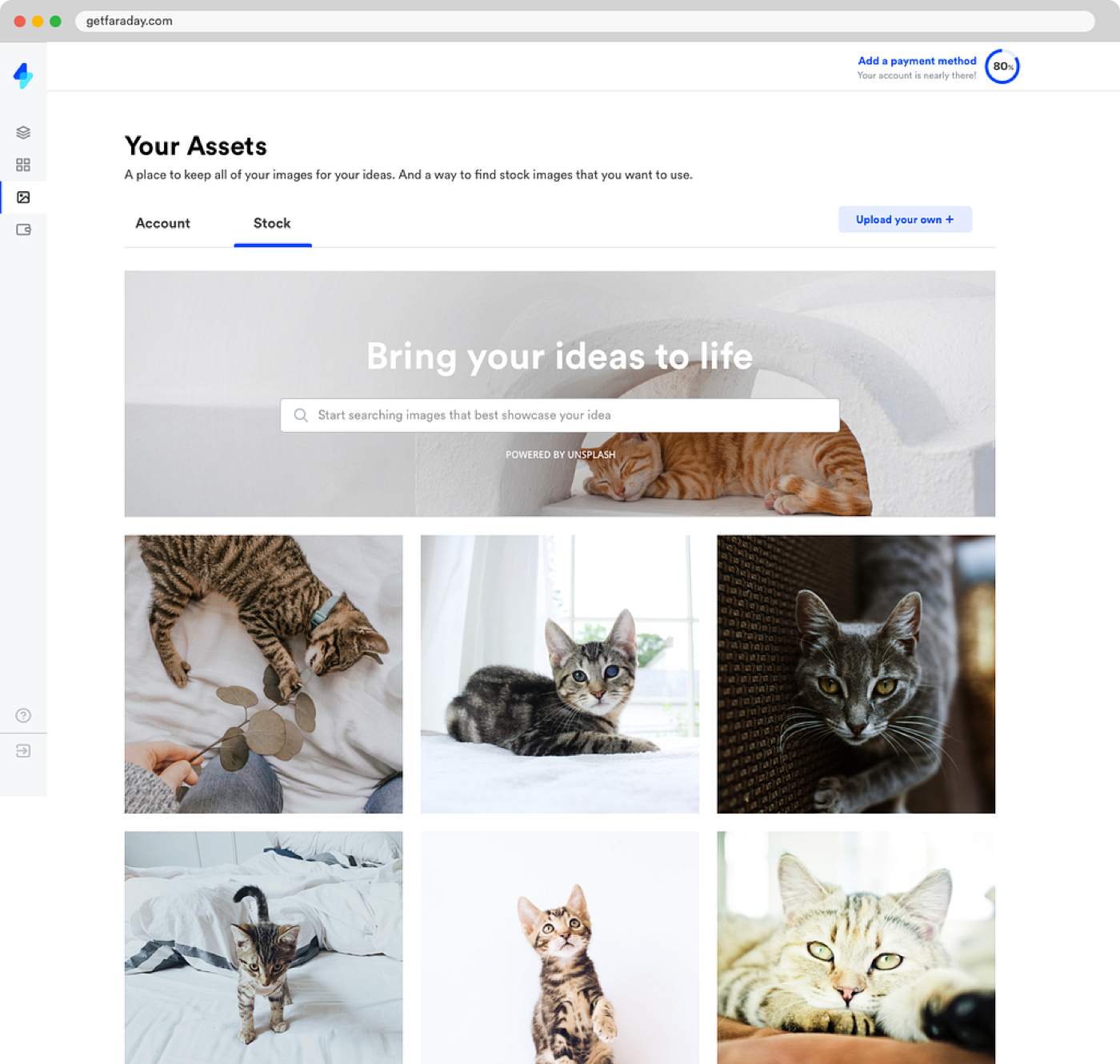
The next part is picking the image to be displayed on your Instagram ad and lead form. Remember, Instagram is a visual social media. Meaning, the image you’ll be using will have a great impact on your intent test. If you don’t have a high-quality image, there’s no need to worry. You can search for royalty-free stock images inside the tool itself.
Next you’ll write your copy fields — ad pitch, headline, subhead, and CTA. To differentiate between the four, here’s what each of them represents:
- Advert copy: This is what appears as the caption of your Instagram ad. It’s important that you write persuasive copy that will pique your customers’ interest.
- Headline: This is the headline of the lead form. You could use this to give a concise pitch on why people should sign-up or sum-up your top-line proposition.
- Subhead: This is the content of the lead form. This is where you can emphasize what your customers are signing up for.
- Call to action (CTA): What will happen after your potential customers sign up? Will they receive more information about your product? Will they receive a freebie?
If you’re confused, here’s what they look like on the ad and on the lead form:
Audience
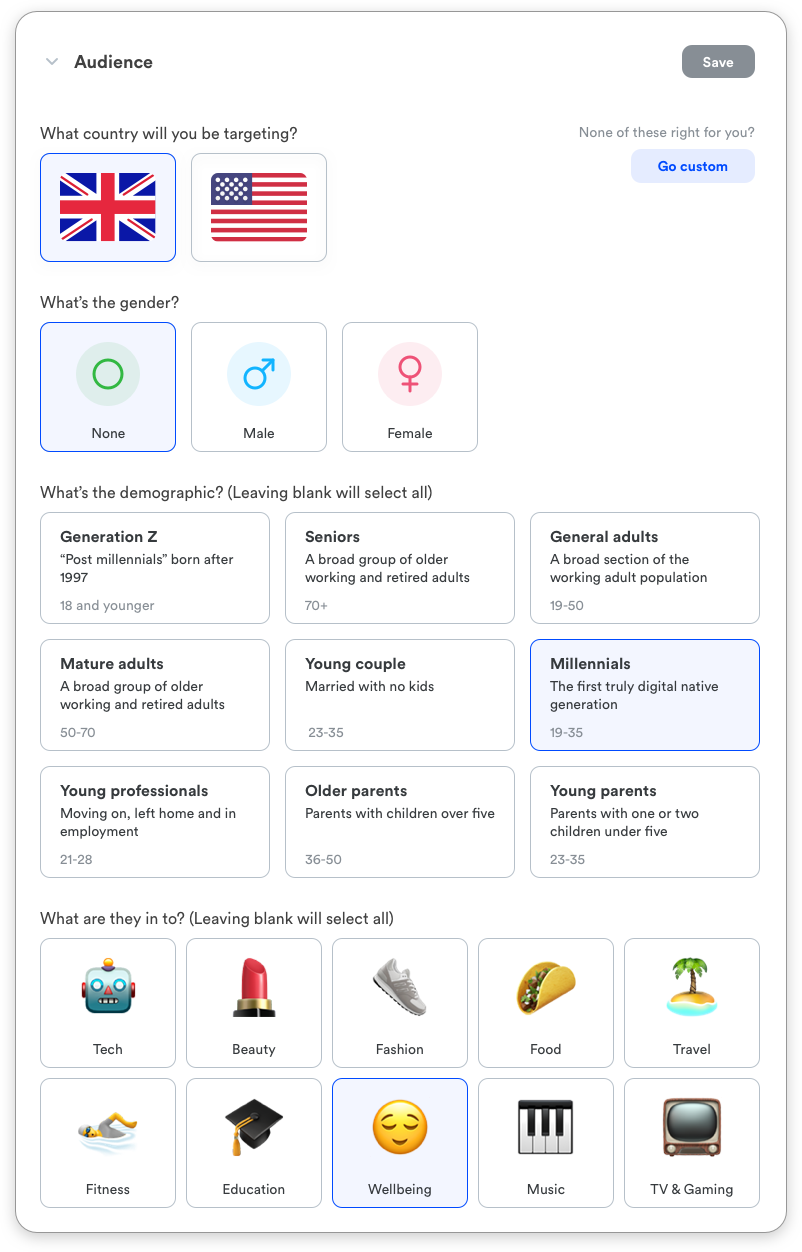
Once you’ve got those nailed down, you’ll need to define your target audience. In this section, you’ll be able to:
- Select the nationality (currently, only UK and US citizens)
- Gender
- Demographic
- Interests
Here’s the twist — all you need to do is click the appropriate option like this:
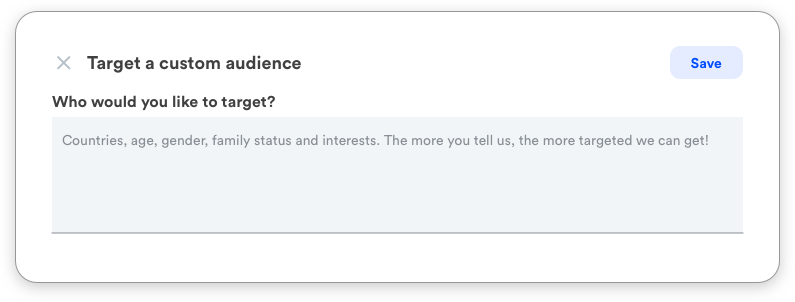
In case you can’t find the right target, or find the parameters currently in place don’t quite fit your particular customer profile, you can also enter your own custom audience. This is where you can note everything about your customer profiles and the Faraday team will target your ad as closely as possible to whatever you input here. The more you tell, the more targeted Faraday can get!
Total Budget
Remember, the intent test targets your audience through paid advertising within Instagram. Meaning, your budget would also dictate how many people your test could potentially reach (represented by “Impressions”).
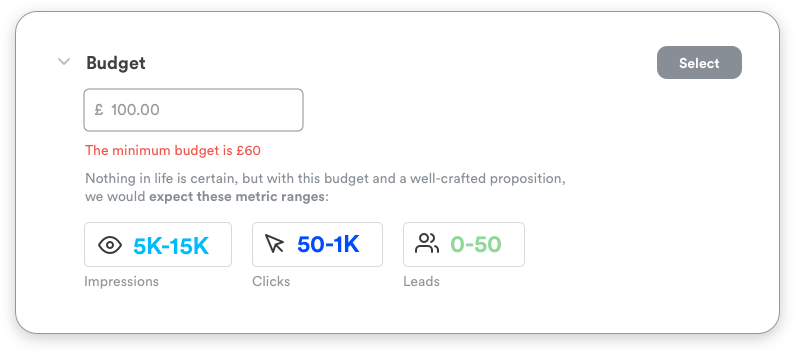
As you can see from the image above, Faraday gives you an estimate on the number of impressions, clicks, and leads your test will get based on your budget. The higher the budget — the more people you reach and the more leads you’re likely to get.
All in all, setting up your own intent test via Faraday’s tool could take up as little as 3 minutes. Awesome! 👏
Intent Test Report
After running your intent test you’ll get a robust report full of important information. Data can often be intimidating and hard to understand, Faraday’s reports beautifully represent your data visually so it’s easy to understand for everyone.
For example, here’s how the overall stats of a published test looks like:
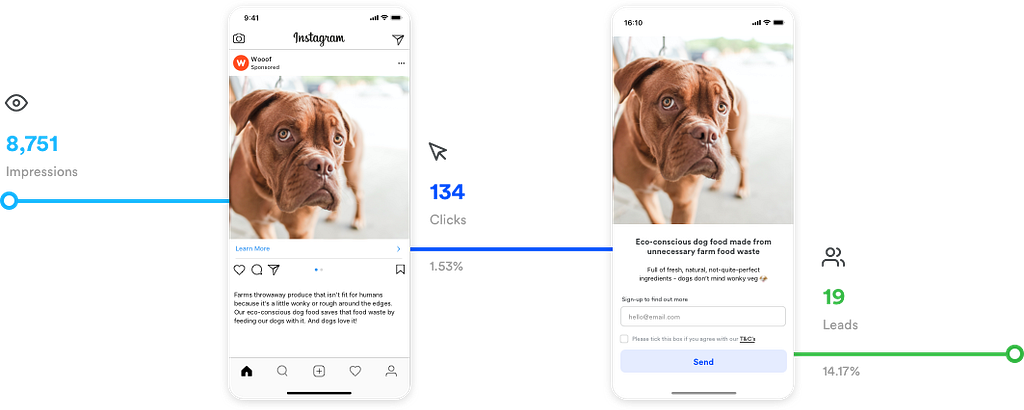
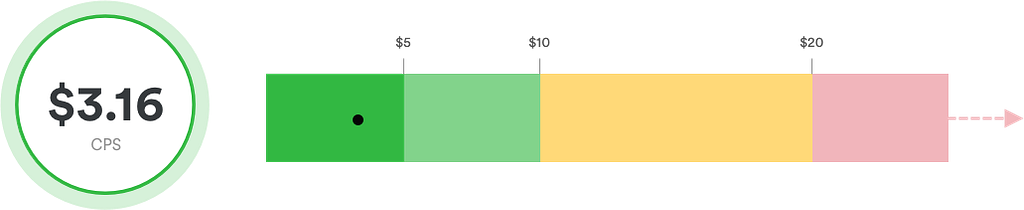
But how do you know if your intent test validates your idea? One of the things the report covers is the cost per sign-up (CPS) score. This score represents the cost of acquiring a sign-up (the sign-ups being a strong signal of early intent.
If a user was willing to hand over their email at this stage, it’s very likely they could be converted into a customer — treat a sign-up as a likely sale/interested party should your business be up and running). Faraday lets you easily know how well your proposition performed by using a meter-like visual, benchmarked against the following criteria — values under $10 are good for consumer goods, Under $5 for mass-market and $10-$20 for niche/luxury products or services.
Aside from knowing how viable your business idea is, you’ll also get information about your potential customers. Faraday gives you a demographic breakdown of your page views by gender and age and how well the test performed respectively for each. Any sign-ups will filter into your ‘Customers’ tab inside Faraday — contacts you can reach out too later to help with business development, user-tests, discounted trials or even acquire as customers.
If that wasn’t enough, there’s a summary section at the bottom of the report page which contains a compressed version of your results in plain words… Plus a few other things. 😉
Easy! 👍
Wrap Up
Intent testing is a great way to validate your business idea or proposition. One of the tools you can use to simplify this process is Faraday’s Intent Test tool which is super-easy to use.
Too often, human habit is to get caught up in a cycle of over-perfecting, over-thinking and constant iteration without even testing the fundamental proposition — the first thing you should ask yourself is: how viable is your business idea to your target audience? An intent test will help you find the answer and gather potential leads.
Faraday is an intent testing tool that helps you test business ideas quickly. Check it out here. Build fun and engaging research experiences in a few clicks.
getfaraday.com
I’d love to get your feedback on the above article and the tool. Please email us at hello@getfaraday.com.
Please clap this article if it was useful. You can click multiple times if you loved it :). — Keep smiling